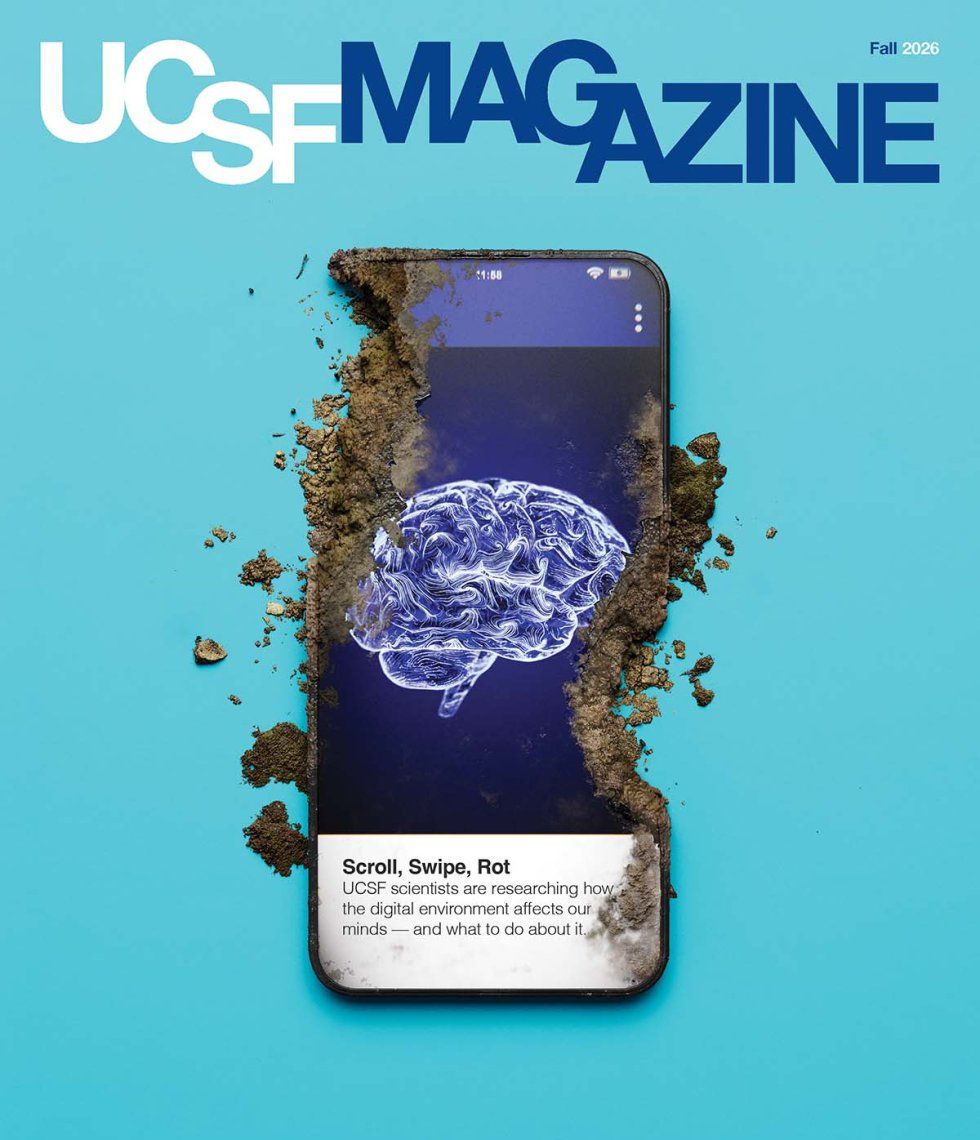

For Jason Nagata, MD, the wake-up call came during the pandemic. A specialist in adolescent eating disorders, he watched as the number of teenagers admitted to his unit tripled. Some weren’t getting better. They were hooked up to heart monitors and facing life-threatening complications, still scrolling through pro-anorexia content on their social media feeds. A few girls even used the hospital’s Wi-Fi to find each other online.
“They were sharing tips on how to continue to lose weight,” says Nagata, an associate professor of pediatrics and 2013 UCSF alum. “We actually had to remove devices from several patients because social media was undermining their recovery.”
He’s not the only UC San Francisco researcher worried that the technology we tote around 24/7 might be hurting our health. For years, neuroscientist Adam Gazzaley, MD, PhD, has argued that we’ve entered a “cognition crisis” — that the information overload supplied by digital devices is degrading our ability to pay attention, make decisions, and regulate our emotions.
Evidence has stacked up. An analysis of 70-plus studies linked heavy consumption of short-form videos to poorer attention spans and impulse control, raising the question of whether “brain rot” is real. Researchers at UC Irvine found that people only stick to a single screen for about 47 seconds now — down from 2.5 minutes in 2004. Reading scores among high school seniors recently hit their lowest point since 1992. It’s the kind of decline that inspired the Financial Times to ask, “Have humans passed peak brain power?”
No single study can answer that question. But scientists are trying to understand the risks of constantly checking our apps, and their work isn’t limited to a particular diagnosis, like ADHD.
“The cognition crisis is not just a clinical problem,” Gazzaley says. “It’s a problem for our species.”
Image
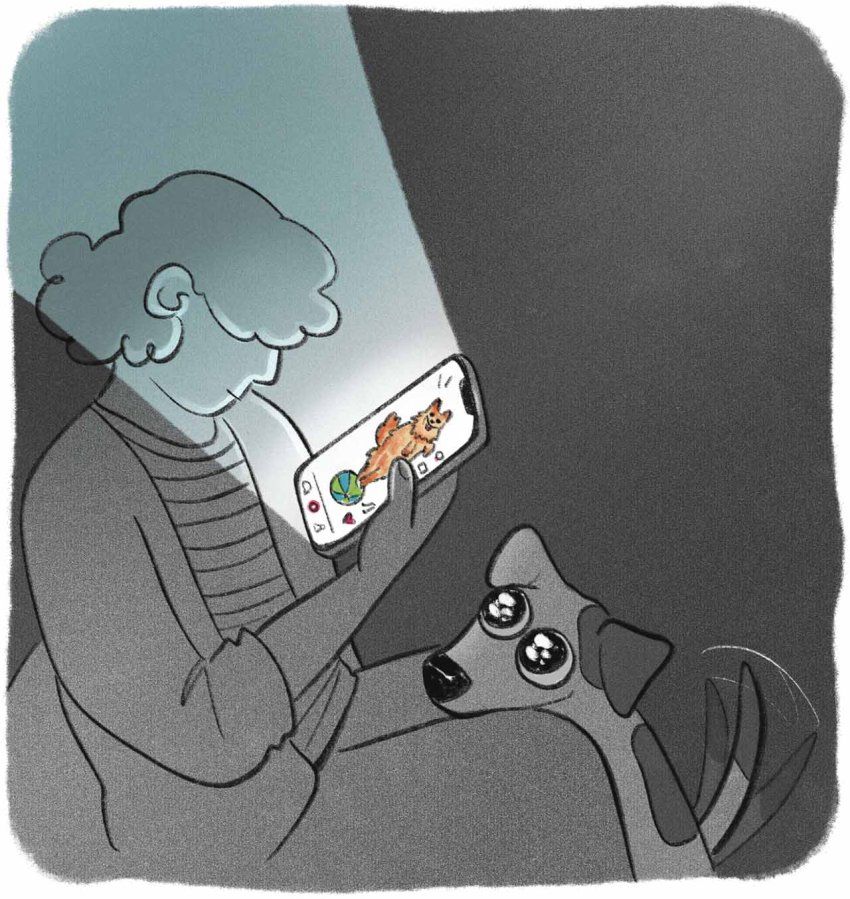
Your Brain on Distraction 😵💫
When Gazzaley started seeing neurology patients in the early 2000s, they often described “senior moments,” like finding themselves by the fridge, unable to recall what they wanted. They lost focus easily. Even then, some attributed it to new technology. Broadband internet, instant messaging, mobile phones — what had seemed impossible just a few years earlier was suddenly everywhere. Gazzaley, now the David Dolby Distinguished Professor, began studying distraction with those patients in mind.
Memory and attention are crucial to cognitive control, a brain system that enables humans to direct their mental resources. If you’ve ever attempted a complex task — say, writing a report — you know how fragile cognitive control can be. Your mind drifts, or your phone vibrates, or a calendar reminder pops up.
“Multitasking” wasn’t even a word until the 1960s, when it was coined to capture a computer’s ability to execute multiple processes, seemingly all at once. At some point, humans started using it to describe our productivity. The thing is, humans are not computers. Experiments in Gazzaley’s lab have found that people aren’t just bad at multitasking; we’re not capable of it.
You can walk and talk because walking requires little effort from your frontal lobe. But when you combine two tasks that require attention — for example, scrolling the news while you’re on a call with a friend — neither goes well. Gazzaley’s research shows that the brain has to shift its resources to the alternative input, then switch back. Even ignoring a distraction takes a toll.
The cognition crisis is not just a clinical problem. It’s a problem for our species.” 🧠
Adam Gazzaley, MD, PhD
Image

The result of rapid switching, on purpose or not? Poorer memory. More errors. And, if you’re caught barely listening, relationship trouble.
“Our cognitive control is really quite limited,” Gazzaley writes in The Distracted Mind: Ancient Brains in a High-Tech World, a book he co-authored with Larry D. Rosen. “The conflict is between our goal-setting abilities, which are so highly evolved ... and our goal-enactment abilities, which have not evolved much.”
Of course, people’s minds wandered long before the internet. Technology doesn’t have some magical ability to break your cognition; it just gives you access to infinite information, plus frequent reminders to open your apps. And that might push your delicate cognitive control past its limits. We also seek out digital disruptions, Gazzaley theorizes, because human brains evolved to forage not just for food but also for useful information. Now that we have access to almost limitless input, some of us tap it constantly — even when info foraging pulls us away from our goals.
When I ask Gazzaley if he’d change anything about his book, which was published in 2016, he shakes his head. If anything, the challenges captured in The Distracted Mind have only gotten worse.
“The book has aged really well in terms of cognitive neuroscience,” he says. “From a societal perspective, it’s sad that it’s aged so well.”
The morning after our interview, I’m feeling sharp. Ambitious. I’m almost done reading Gazzaley’s book — a once-ordinary feat of focus that even some college professors no longer expect of their students. As I pull out a mug to make coffee, my cat jumps on the counter, and her water fountain rushes to mind; when did I last refill it? I load the grounds, hit a button, and scurry to the fountain. As I turn away, I hear the reassuring hum of the espresso machine at work.
When I turn back, the evidence of my hubris is pouring onto the counter, puddling on the floor. My mug sits nearby, forgotten the moment I attempted to multitask.
The Pull of the Infinite Scroll 📱👀
Fragmented attention can have much higher stakes. During the pandemic, a lot of kids used their devices pretty much nonstop. When Nagata and other researchers examined data from young teenagers enrolled in the Adolescent Brain Cognitive Development (ABCD) study, they saw that the teens’ recreational screen time doubled in 2020, from about four hours a day to eight.
“Everyone was glued to their phones,” Nagata says. “Many of these kids were also on Zoom for school for eight hours. That’s like 16 hours online. It’s all day.”
ABCD, the largest U.S. study of brain development, has tracked 12,000 children since 2016, helping scientists unpack the consequences of how kids spend time online. In 2024, Nagata’s team found teenagers’ recreational phone use had ticked up to about 8.5 hours a day — dashing hopes for a post-pandemic drop. The increased screen time was linked to more severe symptoms of inattention, anxiety, and aggression.
Nagata also examined pre-teens, from about age 10 to 13, over a few years. (The legal minimum age for using social media platforms is 13, but two-thirds of 11- and 12-year-olds have accounts.) As they used more social media, their depression symptoms went up 35%. In a study released last fall, Nagata tracked a similar group and found that young teens spending more time on social media tended to do slightly but consistently worse on reading, memory, and vocabulary tests. The more they used it, the more their scores dropped.
Parents used to come to me asking a lot of questions about how to help their kids. Now, a lot of the parents are going, ‘I need help, too.’” 🙏
Jason Nagata, MD
Image

“The effects are kind of all-encompassing,” Nagata says. “Social media is crowding out time for homework and sleep — which are important for cognitive development and learning — and for being with family or friends.
“Then there’s the actual content. If they’re getting cyberbullied or exposed to distressing content, whether it’s violent or sexual or extreme in some other way, they’re not in a mental space where they can think about schoolwork.”
It’s difficult to tease out precisely why cognitive and emotional declines happen. Another recent analysis of the ABCD data suggests that attention problems do not merely occur alongside anxiety and depression; diminished attention might harm emotional regulation and, in turn, worsen mental health. Still, proving that social media causes such harm is tricky. Skeptics argue that kids spend more time on social media because they are already depressed. That’s not, however, the story that ABCD tells: Higher social media use among pre-teens predicted increases in depressive symptoms over time, but their baseline depression did not predict increased social media use. In other words, the social media came first, then the depression.
While there’s no formal diagnosis for social media addiction yet, Nagata’s team has started documenting addiction-like symptoms in young teens. The patterns are similar to what he saw in patients hospitalized with eating disorders: trying to cut back on social media but failing and continuing to use it even when it’s obviously harming them. Social media deploys a variety of features — like the infinite scroll, autoplay of video, and incessant notifications — designed to keep users engaged as long as possible.
Image
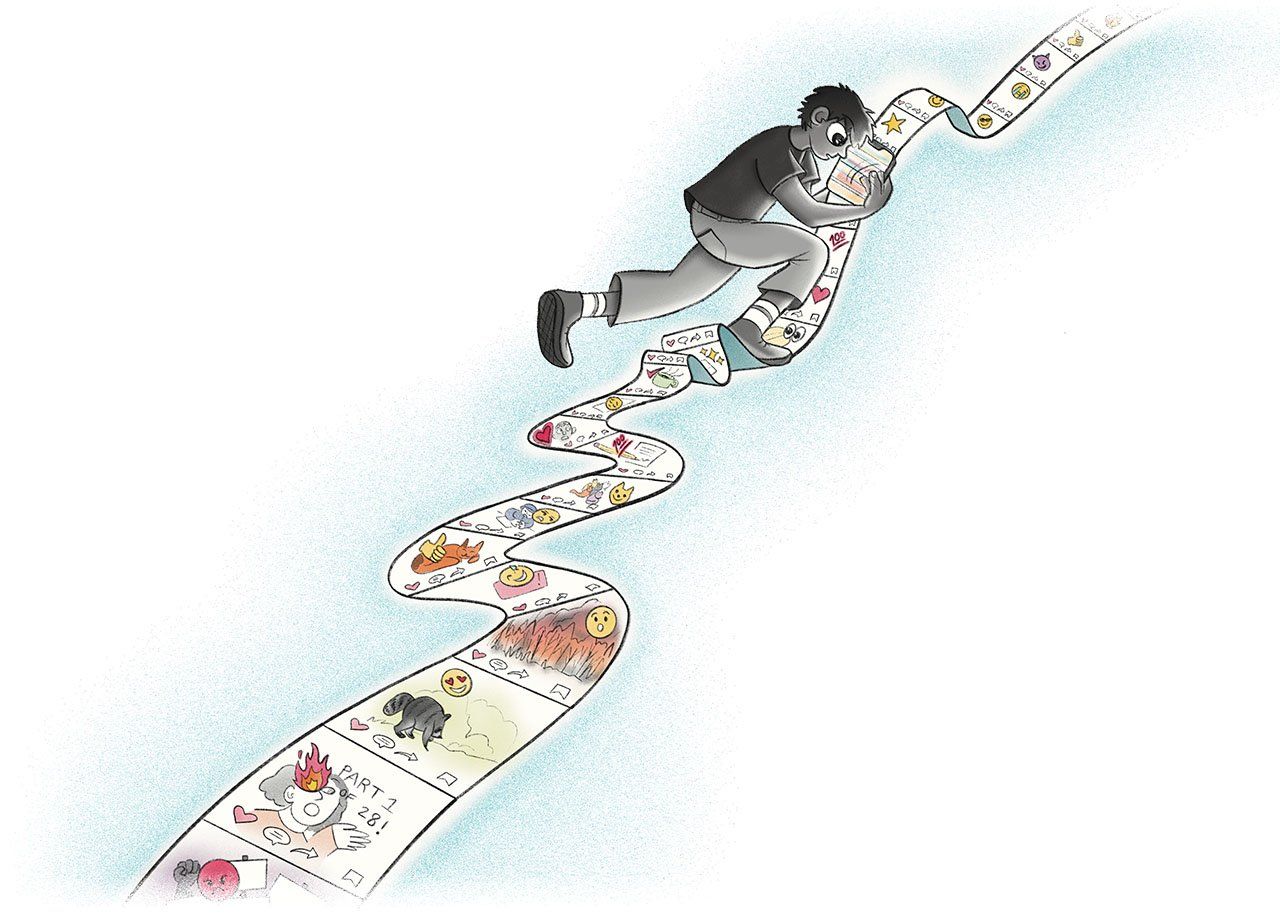
“The psychological theory is called variable reward, and it’s similar to slot machines,” Nagata says. “The features create a loop in which your attention is constantly pulled forward, and then your brain’s reward system reinforces checking behavior, even when the payoff is not consistent.”
Concern about smartphones has led many schools to ban them. Despite the bans, Nagata’s group recently found that the average teenager still spends about 70 minutes a day on smartphones at school. Because the study tracked app usage, the team could see exactly where that time went.
“Social media was the top,” Nagata says. “YouTube was second, and third was video games.”
When Nagata talks to families, they’re concerned about this data but struggling to act on it. The American Academy of Pediatrics once recommended a screen time limit for children: two hours a day. They dropped the guideline in 2016 because almost no one was following it.
“Parents used to come to me asking a lot of questions about how to help their kids,” Nagata says. “Now, a lot of the parents are going, ‘I need help, too.’”
The Misinformation Superhighway 🛣️
Your social media feed says a lot about you. Mine has headlines like “Why some cats bond ... and others just coexist forever” and “The truth about people pleasing” and “Suburban consumer cannot wait to try private equity-backed bakery.” You can infer my preoccupations: animals, psychology, satire, fresh bread. If I didn’t pay for news — 83% of Americans don’t — this feed might supply most of the information I use to understand the world.
That would include a video from a supposed attorney, offering advice on French tax law. Typically, his account indulges my fantasy of retiring in Europe. But this clip was alarming: a 6.5% annual tax on all assets for health care alone? If I hadn’t dug deeper, I might never have learned that it wasn’t true. It was just clickbait.
In an information economy driven chiefly by our attention, there’s a cost to not exercising much control over where we place it. The fragmented attention that Gazzaley studies in the lab and Nagata analyzes in adolescents might also make us worse at discerning whether the information we encounter online is accurate. It’s a real problem, given how quickly misinformation can spread: In a recent analysis of 35 million Facebook posts, researchers found that 3 of every 4 news links were shared without being clicked — suggesting most people endorsed articles they never actually read.
Joe Pierre, MD, a professor of psychiatry, has spent years trying to understand how people come to believe things that aren’t true. In his recent book False: How Mistrust, Disinformation, and Motivated Reasoning Make Us Believe Things That Aren’t True, Pierre details how factual errors and even outright lies flourish in a digital news environment.
“We live in a click-based information economy,” Pierre says. “One way to get clicks is to be salacious, ridiculous, gossipy. Misinformation is also a really good way to get people’s attention. Instead of the free market of opinion, we’ve got a flea market. There may be some hidden gems, but mostly there’s a lot of junk.”
All humans use cognitive shortcuts that, left unchecked, make it difficult to sort fact from fiction. According to Pierre, the main culprit is confirmation bias: favoring information that affirms what we already believe, while reflexively dismissing whatever challenges our beliefs. Pierre says algorithmically curated content feeds — which serve more of whatever you’ve already viewed or liked — fuel “confirmation bias on steroids,” entrenching users’ beliefs and stoking their outrage. In 2025, a Pew survey found that 4 in 5 U.S. adults believe voters from opposing parties cannot agree on basic facts.
“People fundamentally trust very different sources of information now,” says Pierre. “There is no shared universal reality.”
Instead of the free market of opinion, we’ve got a flea market. There may be some hidden gems, but mostly there’s a lot of junk.” 🗑️
Joe Pierre, MD
Image

Unfortunately, the alternative to passively consuming misinformation requires exactly the kind of deliberate, high-effort cognition that digital distraction is making more difficult. Pierre’s antidote, which he calls the “Holy Trinity of truth detection,” involves three habits: intellectual humility (accepting you might be wrong), cognitive flexibility (changing your mind with new evidence), and analytical thinking.
“Analytical thinking means that when I encounter information, I’m slowing down,” Pierre says. “I’m thinking twice. I’m keeping in mind that what I’m reading might not be true, especially if it’s something that validates what I want to believe.”
Pierre’s seen this approach play out. He points to his college roommate, Adam Riess, who was once puzzled by Hubble telescope data that contradicted a prevailing theory of how the universe expands. Riess could have dismissed the data as an anomaly. Instead, he played a key role in the discovery of dark energy and was awarded the 2011 Nobel Prize in Physics.
“He said, ‘Well, we really have to look at this,’ and his data radically changed our ideas about the universe,” Pierre says. “Some people think of that as a sort of flip-flopping. That is actually the strength of science: It’s not dogma.”
But most people don’t approach the internet like a scientist. They just scroll.
Routes to Remediation 😌
A “vigilance task” measures your ability to sustain your attention. It is not fun. You stare at a blank screen. A square briefly blinks into view, and you tap a button to confirm you saw it. That’s it, over and over, for 20 minutes.
“It’s very boring,” says David Ziegler, PhD, an associate professor of neurology and a collaborator of Gazzaley’s at UCSF’s Neuroscape Center. But that’s the point: The Neuroscape team needs to measure how well a participant can focus on something tedious. Otherwise, they won’t be able to tell if the tools they’re developing to hone cognitive control are working.
Their research aims to make exercising your focus less frustrating — “a little gamified,” Ziegler says. He oversees trials of MediTrain, a meditation app that adjusts session length based on your ability to pay attention to your breath. The approach is akin to strength training: Start with a light lift, then increase the load over time. In 2019, the Neuroscape team found that the app significantly improved attention and memory in young adults over six weeks. Ziegler says it’s also benefiting older participants in an ongoing study that tracks changes in cognition, plus markers of stress and well-being.
Image
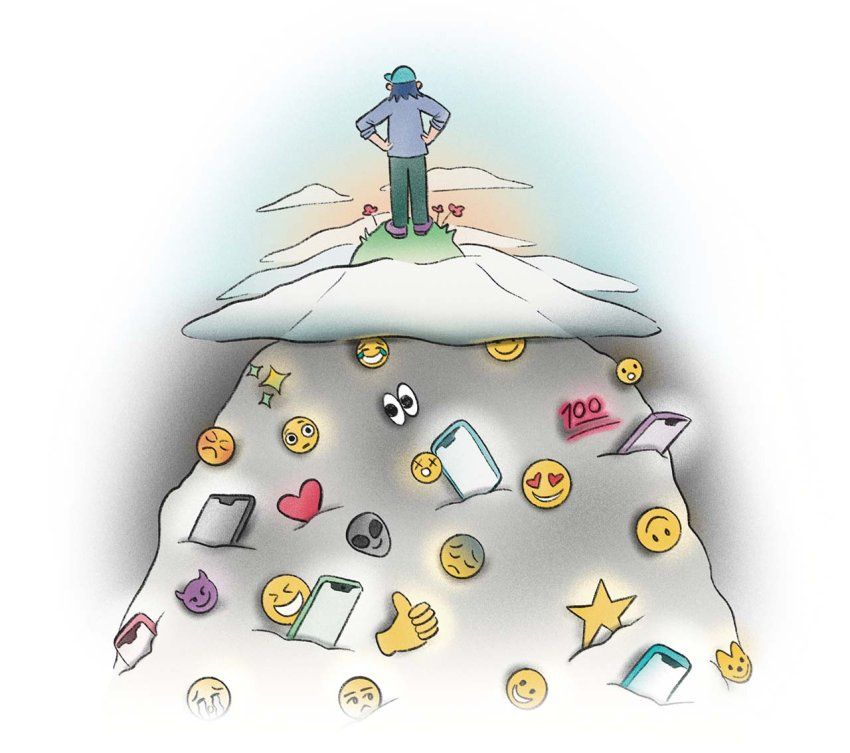
You might expect someone worried about a tech-induced cognition crisis to be a Luddite. Gazzaley’s not. He views technology as a tool; whether it helps or harms is up to those wielding it. Some of Neuroscape’s most promising research has been used to launch therapeutic video games. In 2020, one became the first video game treatment for ADHD in children to receive approval from the U.S. Food and Drug Administration.
Gazzaley sees the games and apps his team studies as “experiential medicine.” He says experiences can selectively activate specific brain networks, a potential upside compared to medications that flood the whole brain, sometimes causing side effects.
“The medicine is the experience,” he says. “Most of the digital tools we’re creating have real-world versions that benefit people, like exercise, music and dance, meditation. We use technology to deliver experience in a way that’s really accessible.”
If you want improved cognition but less tech in your life, Gazzaley gets it. He happens to enjoy video games. He also likes to walk in the woods; spending time in nature has been proven to restore focus and boost mood. And Ziegler is quick to point out that meditation doesn’t require an app. You can do it whenever you want, just by focusing on your breath.
Whether you will is another question. Ideas for how to reduce your time online abound, but habits are tough to change. Nagata suggests making a concrete plan focused on activities you want to add, not take away.
“It’s not enough to just say, ‘I want to limit my screen time,’” Nagata says. “Especially with kids, you have to have a fun alternative, or they’re just going to feel like they’re missing out.”
A household screen-time plan — which the American Academy of Pediatrics urges every family to create — typically includes rules everyone sticks to, like no phones in bedrooms. Nagata says this is the hardest part for parents: modeling the kind of self-control they want for their kids.
“I’m not perfect,” Nagata admits. His children are very young, but there’s a no-phone rule at the dinner table. “If I’m on call at the hospital, I’ll just explain, ‘Daddy has to help a sick kid, so that’s why I’m going to take this call.’ Eventually, they will have to learn to navigate these things, too.”
Broader changes to digital life — changes beyond our individual control — might be on the way. Gazzaley, Nagata, and Pierre all agree that government regulation of social media is needed, especially for young people. And recent landmark lawsuits against social media companies have persuaded juries that the design of the digital platforms is responsible for real-world harm. In August, Meta reached a multibillion-dollar settlement that requires new safeguards for young people using Instagram and Facebook.
“People ask what these companies should be doing, but that’s an ethical question,” Pierre says. “If you look historically at industries like Big Tobacco, when they make changes to make their product safer, that is typically motivated by regulation or class-action lawsuits.”
With AI, are we off-loading things like our creativity and reasoning and thinking? And that, I really worry a lot about. Are we giving up too much of what it means to be human?” 🤖
Adam Gazzaley, MD, PhD
Image
It will take time for researchers to explore how the latest tech innovation, artificial intelligence, is impacting our brains. Already, concerns are brewing about “cognitive off-loading” and “de-skilling.” Even Gazzaley is wrestling with whether AI can be deployed in ways that won’t eventually hurt us.
“We have always built technologies to help us,” Gazzaley says. If he’s got to do long division, for example, he’s using a calculator. “Then it gets more complicated. Do we over-rely on GPS? To-do lists? Reminders? With AI, are we off-loading things like our creativity and reasoning and thinking? And that, I really worry a lot about. Are we giving up too much of what it means to be human?”
Pierre tells me AI is part of why he struggled not to end his book on “a downer note.” When I ask whether he finds any hope in stories about young people buying “dumb” phones and rejecting AI, he’s honest: “I’m very, very skeptical that’s a movement gaining any traction.”
Personally, I’m not sure what to do. A “digital detox” sounds trendy in a way that piques my skepticism, too. But a randomized trial of one — internet access on participants’ phones was blocked for two weeks — boosted sustained attention so much that the difference was comparable to reversing a decade of cognitive aging. They also showed an improvement in depression symptoms larger than what’s reported in many studies of antidepressants.
Still, it’s hard to voluntarily brick a device I use to control everything from my thermostat to my bank account. On vacation a few years ago, when my phone was stolen out of my bag, I found myself running through foreign streets — my route back to our rental barely pieced together by memory and the advice of strangers who tolerated my breathless, rudimentary French. I was desperate to get to my laptop and change my passwords before someone else did.
For the rest of that trip, I had no phone. I was restless, mindlessly searching for it: waking up in the morning, sitting down to lunch, stepping out of the shower. I borrowed a friend’s phone to use the map, but mostly I was forced to shift my attention elsewhere. French radio. A book. Eventually, I could just sit on a beach or at a cafe, instead of reaching for my phone to take a photo.
I’ve gone back to that part of the world a few times now, trying to find that feeling. I want it back.
All Illustrations: Farah Hamade
Take a look behind the artwork for this story and our cover for the Fall 2026 issue.